Keep the boiler you have
Retrofit a conventional hot-water boiler with an external heat-recovery stage. Rainmaker can also be specified for a new installation when a serviceable external economizer makes sense.
Commercial products / Hydronic boiler heat recovery
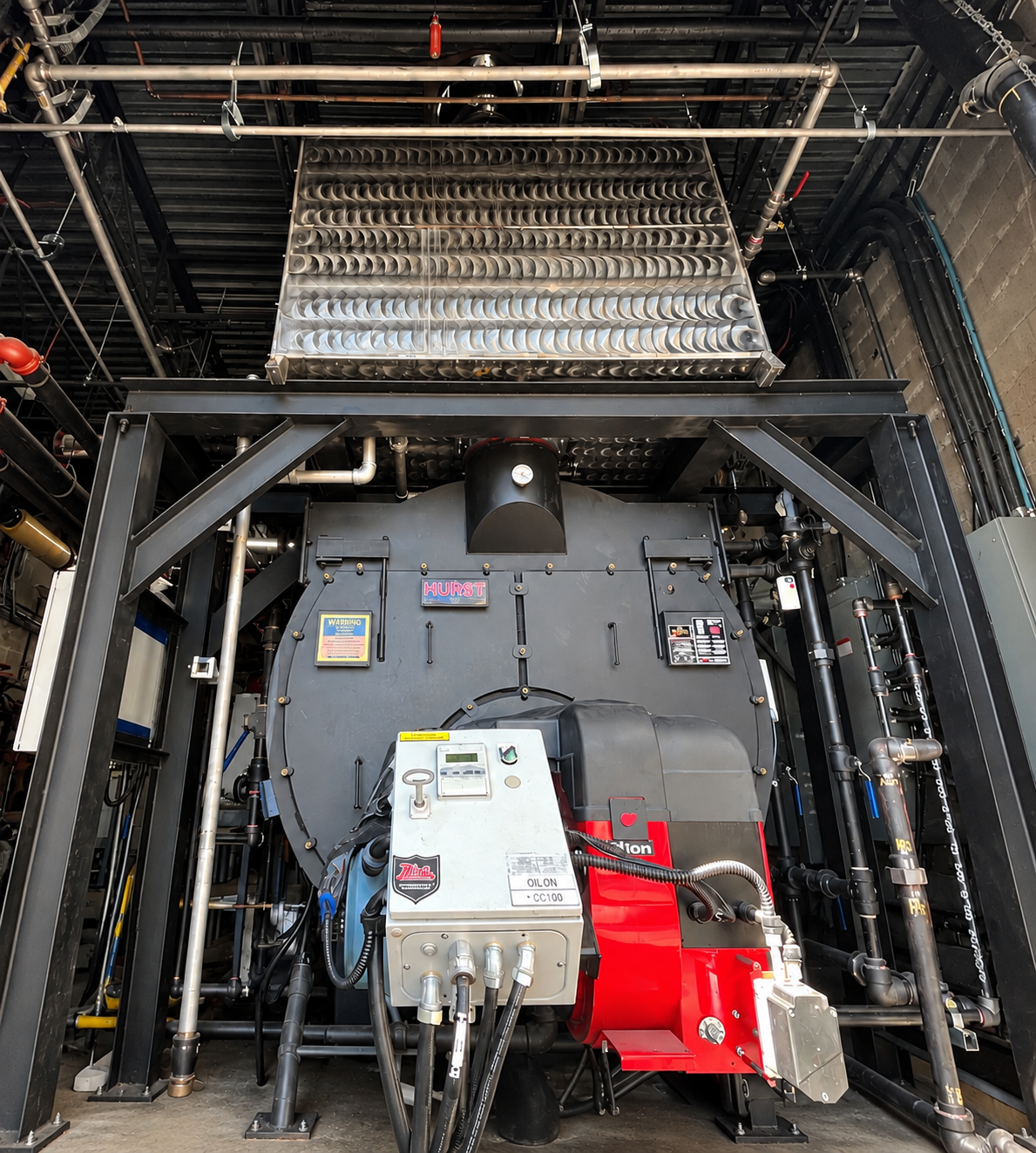
Rainmaker is an external economizer engineered for the high circulating-water flows of hot-water heating systems. Add a heat-recovery stage to a conventional boiler and capture energy that would otherwise leave through the exhaust.
The Rainmaker approach
Replacing an otherwise serviceable boiler solely to gain condensing efficiency can be a costly disruption. Rainmaker adds an external, maintainable heat exchanger to recover exhaust energy with the boiler and water circuit evaluated as a system.
Under the same operating conditions, a properly selected Rainmaker can bring a conventional boiler to condensing-boiler efficiency. The outcome depends on return-water temperature, load profile, fuel, and the available exhaust heat sink.
Retrofit a conventional hot-water boiler with an external heat-recovery stage. Rainmaker can also be specified for a new installation when a serviceable external economizer makes sense.
When return-water temperature and operation allow condensation, Rainmaker captures both sensible heat and latent heat from water vapor in the exhaust. It continues recovering sensible heat when water temperature rises above condensing conditions.
An accessible external installation allows inspection, drainage planning and service without placing the heat-recovery bundle inside the boiler pressure vessel.
Configuration matters
Different exhaust flow paths and water temperatures call for different arrangements. A staged design can preheat water first, then use colder water where condensing recovery is most effective.
Our Type III internal three-pass configuration supports deeper multistage condensing recovery while directing condensate to an isolated collection area rather than back toward the boiler. The final arrangement is selected for the site, not assumed from a model name.
Explore technical documentationDesigned for actual operating conditions
Hydronic boilers circulate substantially more water than a typical feedwater economizer. Rainmaker is designed around the actual flow, entering-water temperature, pressure and allowable water-side pressure drop.
Gas flow, draft, venting and condensate handling determine the casing and connection arrangement. An induced-draft fan can be evaluated when the existing draft is insufficient.
316 stainless steel tubing and corrosion-resistant gas-side construction address wet exhaust. Material selections, access and optional service features are confirmed for the fuel and operating profile.
Oil-fired standby operation may be accommodated in an application-specific arrangement. Fuel, temperatures, bypass strategy and materials must be reviewed before selecting the configuration.
Start with your boiler
Share the boiler make and capacity, fuel, exhaust conditions, circulating-water temperatures and flow, and available installation space. We can assess the suitable Rainmaker configuration and expected performance.